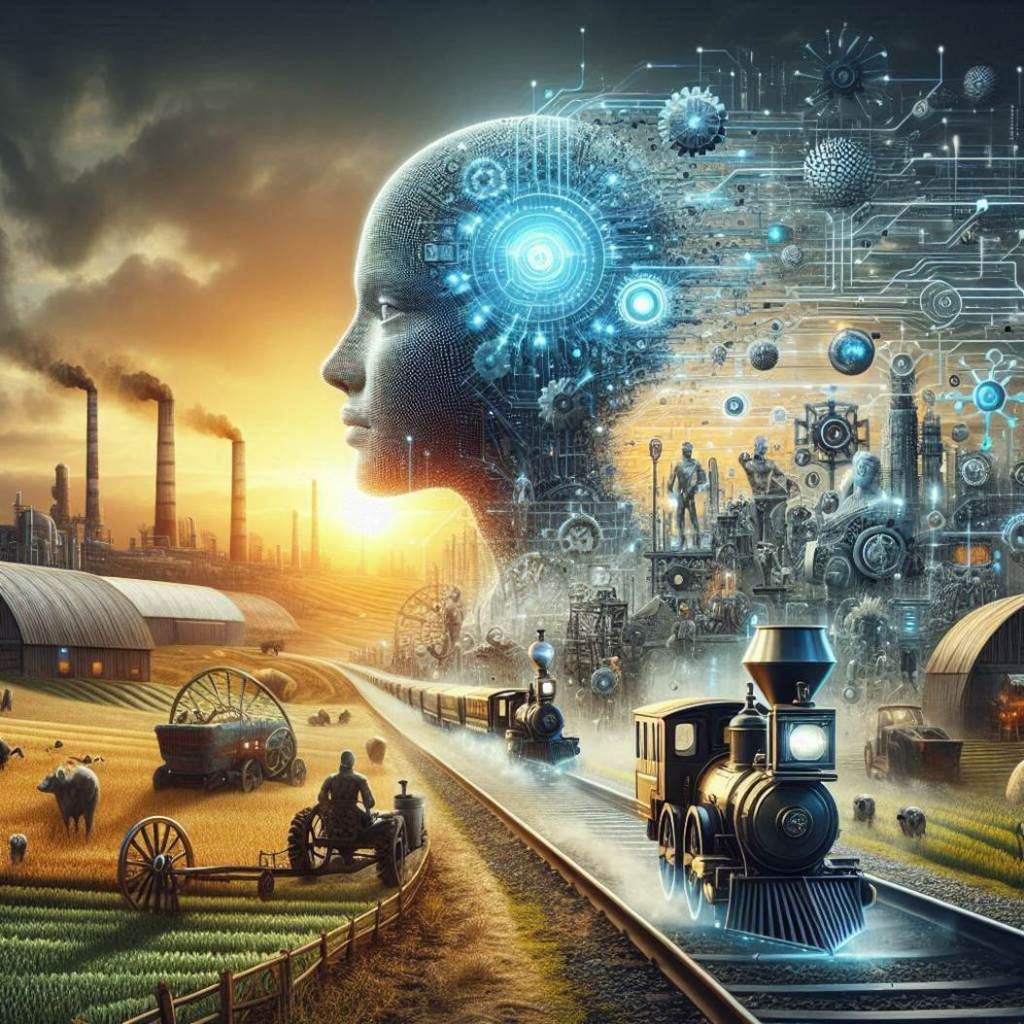
Imagine a world where AI not only drives technological advancements but also transforms our daily lives. In my journey towards self-sufficiency, I’ve had numerous discussions about the impact of technology on society. While I won’t delve into AI’s role in farming today, let’s explore its broader implications.
What the discussions have done is started me thinking about technology change and the impact on society and the environment. In this post I’m writing mostly about technology leadership with some of my thoughts on other significant technology changes that impact society, farming in particular.
Software engineering is at an inflection point. This year AI has begun to shift from a tool supporting software development to a driving force as to how software systems are built. Further, it’s reshaping how companies strategize and build new products, with productivity being a central theme.
Just as farmers faced uncertainty during the industrial revolution, software engineers today are grappling with questions about their job security. Will AI make their roles obsolete?
In my opinion, while the traditional role of a software engineer will evolve, it won’t disappear overnight. AI, though powerful, is still a sophisticated pattern-matching tool that excels with clear instructions. This makes it an excellent aid for coding.
I firmly believe that AI presents immense opportunities. It allows software development managers to return to coding and solving business problems. Product managers can quickly build prototypes, and startups can scale their software development with fewer resources.
In May, I used AI to start building a computer game prototype. It exceeded my expectations by producing the first code. It wasn’t perfect working software though. I’ll share more about this journey in a future post, but some first observations are shared below.
But first, some technology leadership thoughts.
Technology Leadership in the Age of AI
I’m excited to think that AI will result in less meetings and more time spent solving business problems. Meetings will still be required, for coordinating the organisation, discussing strategy, making decisions, and discuss complex problems. The real improvement will be in communication – setting expectations for software teams. Rather than trying to explain a problem or idea, you can use AI to communicate it. AI can build the outline of a software solution to solve the problem. You can even use AI to explain the software written. The code and explanation can be shared with the engineers. They will use this information to build out the final solution that is a Likeable Product – appreciated by users and software engineers alike.
I firmly believe production ready software solutions will be built at pace, far faster than imagined even 2 years ago. This is already being talked about online and by industry leaders.
One key observation is that AI is not perfect. It requires significant guidance and a human partner with domain expertise to discover when something is amiss. For instance, while building a game, I encountered several issues that needed manual intervention.
AI solutions aren’t perfect – they still need lots of testing
I experienced problems with AI when building the game, I mentioned earlier. It’s a hexagonal board game; I asked GitHub Co-pilot (GPT-4.1) to create the UI and the ability to move pieces on the UI. It did this for me but introduced some bugs in its own code and even the unit tests it generated.
The problem was that the AI copilot used axial rather than cube coordinate logic. The result was that it was possible to move playing pieces further than allowed. Annoying in a game but costly if there had been software for a delivery service calculating optimal delivery routes.
I attempted multiple different prompts and explanations to Copilot. However, all of them failed to solve the problem. I had to fall back to traditional research and reading articles. This helped me understand the problem and fix the code as well as the unit tests.
The choice of AI assistance, using of GPT, over say Claude AI, could be the reason for the issue. If that were the case this highlights a strong need to understand how AI will behave. So right now, the ability to do problem solving and research are still an essential skill for software developers.
Some interesting links
Back to my starting point, my thoughts on the impact of technology on society (farming and AI).
Farming, the Industrial Revolution, and AI: Just Some Thoughts
Here’s my comparison of the industrial revolution to the technology inflection happening now.
Farming: Mechanization of Agriculture
Technology: Automation of mundane tasks
- Introduction of machinery such as tractors, ploughs, and harvesters.
- Increased efficiency and productivity in farming.
- Reduction in manual labour and time required for farming tasks.
In the 1990’s I see the shift from paper-based ticket systems in telecoms companies to software. This change increased productivity among individuals. It allowed them to focus on higher value and more interesting activities. Some people transitioned from administrative work to engineering roles. This was all positive for companies and individuals.
As I mentioned above AI will make software engineers more productive and efficient. But more importantly, it will automate mundane business activities. This automation will enable business people to be more creative. One area I can see this happening is in accounting. It will make it easier and faster to analyze accounts. The key here is ensuring complete, accurate, data is the input to the automation and this is not easy. Legacy software systems and delivering new products quickly make robust tracking of money movements a difficult problem to solve well.
Technological Advancements
Farming:
- Development of irrigation systems and techniques.
- Use of fertilizers and pesticides to enhance crop yield.
- Genetic modification and selective breeding for better crop varieties.
Advancements in technology enables more to be produced at a higher quality with less effort. But, what about the environment?
Economic Impact
- Shift from subsistence farming to commercial agriculture.
- Growth of agribusiness and large-scale farming operations.
- Changes in the rural economy and employment patterns.
Positives and negatives here. It was essential to be able to produce more to support growing populations. In some ways, this had a flywheel effect. Having more dependable food meant less famine. This led to a greater population, which demanded more food. The cycle continues – demand and supply grows each year.
Being capable of producing software solutions faster will put pressure on engineering teams and technology companies to produce faster. The pace of change may well be hard for society to cope with, impacting mental health. The health issues will cause negative economic impact.
I’m not even going to try to predict the economic impact of AI on society. My view is people will be far more productive. I’m not sure people will have more free time because of AI though.
Environmental Impact
- Effects of industrial farming on soil health and fertility.
- Impact on biodiversity and ecosystems.
- Issues related to pollution and sustainability.
I’ve read comments on how using OpenAI/ChatGPT consumes water and electricity, with an impact on the environment. The discussions seem to vary in opinion on the costs. Example articles are: The Environmental Impact of ChatGPT | Earth.Org, What your ChatGPT use is doing to the environment.
It’s a difficult topic, where I am sure many strong opinions can be heard. Should engineers be considering not just the monetary cost of implementing software solutions but also the environmental impact?
Social Impact
- Changes in rural communities and lifestyles.
- Migration from rural to urban areas.
- Impact on traditional farming practices and knowledge.
A good summary of the AI inflection point can be found in this LinkedIn post by Stanislav Beliaev
Conclusion
The impact of technology on society is, and has been, profound and far-reaching. As we navigate this AI-driven evolution, it’s crucial to embrace the opportunities while being mindful of the challenges. What are your thoughts on the future of AI and technology leadership? Share your insights in the comments below
 Gary Thompson Random Thoughts
Leave a comment